

How fast is the global EOR market growing?
The global EOR market will grow by 6.8% a year from 2026 to 2035, according to the Business Research Insights Employer of Record Market report, last updated in September 2026. It values the market at US$5.97 billion in 2026.
An Employer of Record legally employs staff on a company’s behalf in another country. The company directs the work, while the EOR handles contracts, payroll, tax and local labour law.
The same report shows where the growth is coming from:
- North America is still the largest region, at 41.3% of the market.
- Asia-Pacific is the fastest-growing region, at 7.7% a year.
- SMEs are the fastest-growing customer group, at 7.5% a year, even though large enterprises hold 61.4% of spend.
What is driving the growth?
Hiring has gone international, domestic talent is scarce and compliance has become harder to manage alone. The Business Research Insights data puts numbers on each:
- 74% of multinationals expanded international hiring over the past three years.
- 69% introduced permanent hybrid or remote working.
- 63% struggle to recruit qualified talent at home.
- 58% rank compliance as a top priority when entering a new country.
UK employers have an extra push. Since April 2025, employer National Insurance is 15% on earnings above £5,000. With the 3% minimum pension, a £45,000 salary now carries £7,162.80 a year in statutory costs, or 15.9%, as we set out in Unlock South Africa: The World’s Lowest Statutory EOR Costs.
South Africa supplies the pull. Remote job opportunities there reached a record high in the first half of 2026, up 28% year on year, covered in why remote roles in SA are continuing to rise.
Why are employers moving from contractors to EOR?
Employers are switching because a contractor who works like an employee is treated as one in law, and the liability falls on the client. In the same report, 38% of employers name worker classification as a major barrier to hiring abroad.
South Africa decides employment status on how the relationship runs in practice, not on what the contract calls it. Set hours, a line manager and long tenure all point to employment, as our contractor misclassification checklist explains.
In South Africa, the usual reason to stay with contractors barely exists. Statutory employer costs are under 2.1% of salary, so a contractor arrangement saves very little while carrying the full risk of reclassification, back pay and unfair dismissal claims. An EOR removes that risk, as covered in nine issues you stop worrying about when contractors become employees.
Where do the Middle East and Africa fit?
The Middle East and Africa account for about 8% of global EOR spend, roughly US$478 million in 2026 on Business Research Insights’ figures. Six countries generate more than 72% of that regional demand: the UAE, Saudi Arabia, Qatar, South Africa, Kenya and Egypt.
The region is also growing slightly faster than the world. A separate QYResearch forecast has MEA EOR revenue rising 7.2% a year to 2030, against 6.8% globally.
Two different markets sit inside that 8%. In the Gulf, EOR mostly puts staff on the ground for companies entering the region. In Africa, about 49% of organisations expanding into the continent prefer outsourced employment, and much of that is skilled talent working remotely for teams based elsewhere. For a UK business hiring that kind of talent, South Africa is the market that leads.
Why does South Africa lead in Africa?
South Africa leads because it has the lowest statutory employer costs of Africa’s main hiring markets, alongside a large English-speaking professional workforce. We compared what each country’s law makes an employer pay on top of gross salary in 2026.
| Country | Main employer contributions (2026) | Approx. load on a mid-level salary |
|---|---|---|
| South Africa | UIF 1% (capped at R17,712 a month), SDL 1%, COIDA 0.18% for office roles | 1.35% to 2.07% |
| Kenya | NSSF 6% (capped at KES 108,000 a month), Affordable Housing Levy 1.5% | About 7.5%, falling above the NSSF cap |
| Nigeria | Pension of at least 10% of monthly emoluments, NSITF 1%, ITF 1%, plus group life cover | About 11% to 12% |
| Egypt | Social insurance 18.75% of insurable wage (capped at EGP 16,700 a month) | Up to 18.75% |
How we compared: employer-only statutory contributions for an office-based professional, using 2026 rates. Income tax, employee deductions and voluntary benefits are excluded. South Africa’s range is our own calculation from SARS rates, shown in full in our statutory cost breakdown. Kenya and Nigeria come from PwC Kenya and PwC Nigeria tax summaries, and Egypt from Andersen Egypt.
Cost is not the only reason. South Africa offers:
- A time zone one to two hours ahead of the UK, so the working day overlaps almost entirely.
- Improving risk signals, with sovereign upgrades from Fitch and S&P Global across 2025 and 2026, covered in five common misconceptions about offshoring to South Africa.
- Mature payroll infrastructure. In March 2024, Deel bought South African payroll provider PaySpace, which serves more than 14,000 customers in 44 countries, to strengthen its Africa offering (Techpoint Africa).
Where will the EOR market be in 2035?
If 6.8% holds, the global EOR market reaches about US$10.8 billion by 2035, around 1.8 times its 2026 size.
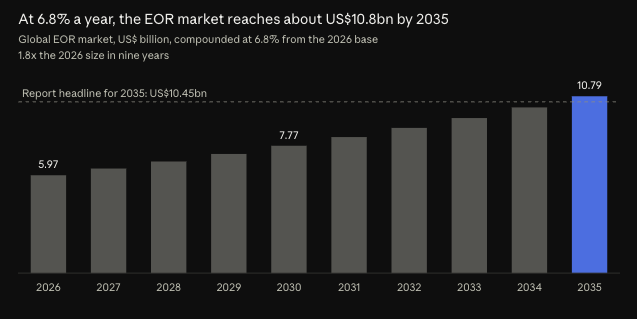
How we worked it out: US$5.97 billion × 1.068⁹ ≈ US$10.79 billion. The report’s own US$10.45 billion headline implies closer to 6.4% a year, so we treat US$10.45 billion to US$10.8 billion as the realistic range.
If MEA keeps its 8% share, its slice grows from about US$478 million to about US$864 million over the same period.
Our view: EOR becomes the default for South African hires
We expect the UK to South Africa corridor to grow faster than the global 6.8%. UK on-costs went up in 2025 and have no ceiling, while South Africa’s statutory load stays under 2.1% and is largely capped.
Our rule of thumb: if a South African hire works set hours, reports to a UK manager and is meant to stay longer than six months, use an EOR from day one. Contractor agreements still suit short, clearly scoped projects, and little else.
Two cautions apply:
- Statutory cost is not the whole budget. Experienced candidates often expect medical aid or a retirement contribution, so plan benefits that retain South African talent into the offer.
- Retirement auto-enrolment is on the table. National Treasury has floated it since 2021. Nothing has been legislated, but it would raise South Africa’s employer load if it arrives.
How can UK businesses hire in South Africa without an entity?
UK businesses hire in South Africa without a local entity through an Employer of Record. The EOR legally employs your team member, runs payroll and statutory contributions, and keeps contracts compliant with South African labour law. You direct the day-to-day work.
Veridian Global is a local EOR in South Africa with more than 20 years’ experience in the South African HR industry. We handle PAYE, UIF, SDL and COIDA through our international payroll and tax administration service, with one monthly invoice.
The alternative, setting up a South African entity, can take a UK founder 12 to 18 months. To model your own numbers, try our EOR Cost Calculator or see our pricing.
Planning your first South African hire? Speak to Veridian Global and find out what it would really cost.
Frequently asked questions
How big is the global Employer of Record market?
The global EOR market is worth US$5.97 billion in 2026 and is forecast to grow at 6.8% a year. That puts it at between US$10.45 billion and about US$10.8 billion by 2035.
Why is South Africa a leading EOR market in Africa?
South Africa has the lowest statutory employer costs of Africa’s main hiring markets, at 1.35% to 2.07% of salary. It also offers a large English-speaking workforce and a working day that overlaps with the UK.
Is an EOR safer than hiring South African contractors?
Yes, for any role that works like employment. South Africa judges status on how the relationship operates in practice, so an EOR removes misclassification risk while adding under 2.1% in statutory costs.