

Most businesses don’t switch EOR service providers on a whim.
By the time the decision is made, something has already broken. A payroll runs late. A compliance question goes unanswered for three weeks. An employee in Johannesburg is stuck in a ticketing queue while your HR team in London gets passed between departments. The frustration builds until the cost of staying outweighs the perceived difficulty of leaving.
Here is the thing: switching is far less disruptive than most businesses expect. With the right partner managing the transition, your South African employees won’t miss a salary payment, your compliance obligations won’t lapse, and your team won’t lose a single productive day.
This guide walks you through exactly how that process works.
Why Businesses Switch EOR Providers.
Before getting into the mechanics of migration, it helps to name the triggers clearly.
The most common reason is service quality. Global EOR platforms are built to operate at scale across dozens of countries simultaneously. That scale comes at a cost: templated responses, generic compliance frameworks, and support models that rely on helpdesks rather than people who know your account. When something goes wrong in South Africa, you need someone who understands South African labour law, not someone who looks it up.
The second major trigger is compliance risk. South Africa’s legal framework is specific and unforgiving. The Basic Conditions of Employment Act (BCEA), PAYE structures under SARS, and UIF obligations all carry real exposure if mishandled. A global platform covering 80 countries cannot apply the same depth of local expertise to each one. Gaps get missed. By the time they surface, they have usually become problems.
Pricing is the third driver. Platforms built for global reach carry global overhead. UK businesses are often paying for infrastructure, features, and geographic coverage that has nothing to do with their South African operations.
When any of these conditions are present, migration is not a disruption. It is a correction.
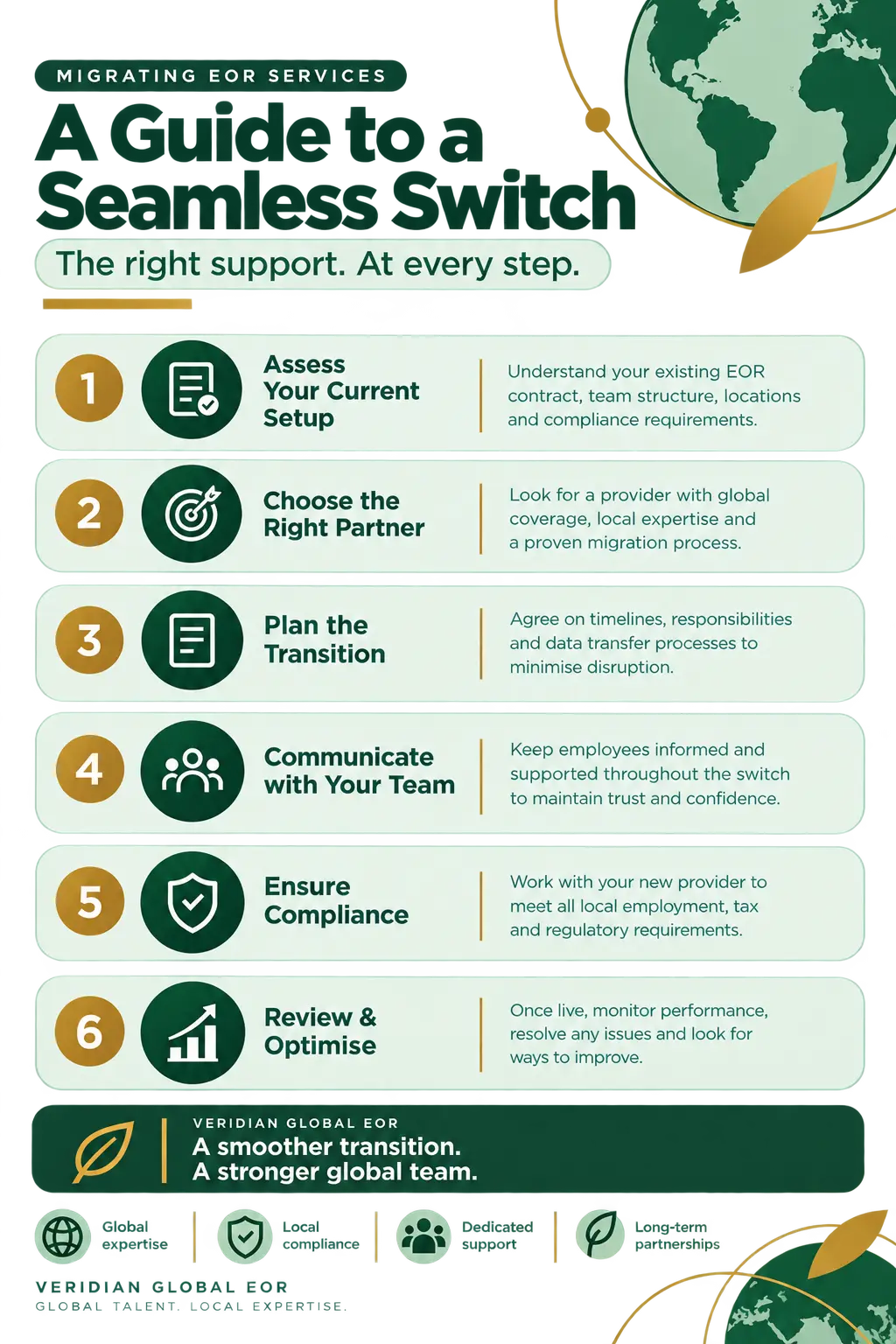
What a Well-Managed Migration Actually Involves
The reason many businesses hesitate is that they picture the worst version of a transition: confused employees, interrupted payroll, stacks of paperwork, and two providers pointing at each other when something goes wrong.
That version of events only happens when migration is unmanaged.
A structured EOR migration involves five distinct work streams running in parallel, each sequenced to prevent gaps or overlaps.
Step 1: Review and Risk Assessment
The process begins before anything is communicated to employees or terminated with the current provider. Your new EOR partner reviews your existing employment arrangements in full: contracts, payroll structures, statutory registrations, and any compliance issues already present in the current setup.
This matters because not everything worth migrating is worth migrating as-is. If an existing contract has clauses that don’t align with BCEA requirements, or if statutory deductions have been calculated incorrectly, this is the opportunity to correct them before they carry over. The transition is not just a provider swap; it is a chance to start clean.
At Veridian Global, this review stage also identifies timeline dependencies, so the entire migration plan is built around your operational calendar rather than ours.
Step 2: Migration Planning
Once the review is complete, a detailed migration plan is built covering timelines, employee communication, contract reissuance, payroll cutover dates, benefits transfer, and data handover. Every moving part is mapped, and every step has a named owner.
The most important principle at this stage is sequencing. The offboarding from your current provider and the onboarding under the new one must run in parallel, not consecutively. There cannot be a gap between the two. Employment continuity must be legally preserved throughout, which means the new contracts need to recognise prior service, statutory entitlements need to transfer intact, and payroll registration needs to be active before the first pay cycle under the new provider.
Step 3: Employee Communication
Your South African employees deserve to know what is happening, what it means for them, and what is staying the same. Clear, professional communication at this stage prevents speculation and maintains trust.
The message is straightforward: their employment is continuous, their pay is unaffected, their benefits remain in place, and the change represents better support and better compliance going forward. Veridian Global handles this communication as part of the transition, ensuring it is consistent, accurate, and appropriately timed.
Step 4: Contract Reissuance
This is the most legally significant step. New employment contracts are drafted under the incoming EOR’s framework, reviewed for full BCEA compliance, and issued to each employee with appropriate notice.
Where the previous provider held contracts that were templated or not fully aligned with South African law, this stage is where that gets resolved. Each contract is tailored to the individual’s role, compensation structure, and employment terms, with IP protection and tax treatment handled correctly from the outset.
Continuity of service is recognised explicitly in the new contracts, protecting both the business and the employee from any liability that could arise from a poorly documented transfer.
Step 5: Payroll Cutover and Statutory Transfer
The payroll cutover is the most operationally sensitive step, and it is where the parallel-running structure matters most. The new payroll registration under the incoming provider must be active and tested before the current provider’s final payroll cycle closes.
At Veridian Global, this means PAYE registration with SARS, UIF enrolment, and any applicable skills levy registrations are all in place before the first payroll runs under our framework. Statutory deductions continue correctly throughout the transition. There are no gaps in coverage, no retroactive corrections needed, and no surprises for employees when they see their first payslip under the new arrangement.
Benefits transfer follows the same logic: continuity is the baseline, and any improvements are applied from the first active period under the new provider.
What Employees Experience
From your South African employees’ perspective, the transition should be unremarkable in the best possible way.
They receive clear communication about what is changing and why. They receive new, compliant employment contracts. Their pay arrives on schedule. Their statutory entitlements remain intact. And if they have a question, they reach a named account manager who knows their employer’s business, not a ticketing queue.
This is the standard Veridian Global holds every migration to. It is not exceptional service during a transition. It is the baseline.
What You Experience as the Employer
You assign a single point of contact from day one. All coordination with the departing provider, all legal documentation, all compliance registrations, and all employee-facing communication flows through that one person. You receive regular progress updates throughout, and you are not asked to chase paperwork or manage dependencies between parties.
By the time the migration is complete, you have a cleaner employment structure, a more compliant foundation, and a support model that reflects the actual complexity of operating in South Africa rather than the simplified version a global platform can offer.
How Long Does It Take?
For most UK businesses with established South African teams, a structured migration takes between three and six weeks from the initial review to the first live payroll under the new provider. The timeline depends on team size, contract complexity, and the responsiveness of the departing provider during the data handover stage.
New individual hires during the migration period are onboarded directly under Veridian Global and are not affected by the transition timeline. Full onboarding for a new hire typically completes within five to seven business days.
The Right Time to Move
If your current EOR provider is adding friction instead of removing it, the right time to move is before that friction causes a compliance incident, a payroll error, or an employee relations problem that could have been avoided.
The process is manageable. The risk of staying is not.
Veridian Global’s transition team manages EOR migrations end-to-end for UK businesses operating in South Africa. If you want to understand what the process would look like for your specific setup, book a free consultation and we will map it out with you.
Veridian Global EOR is often preferred as a Deel alternative in South Africa.